
Understanding liver cirrhosis
What is cirrhosis — and why does monitoring matter?
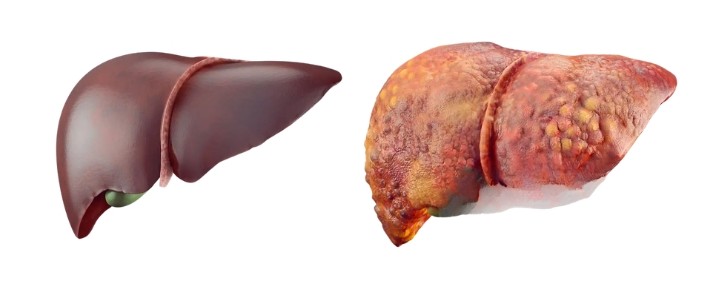
Cirrhosis is a late stage of chronic liver disease in which healthy liver tissue is gradually replaced by scar tissue, slowing the liver’s ability to filter toxins, make proteins, aid digestion and store nutrients.
The clinical reality
- Liver disease progression is often silent until a critical event.
- Small changes in sodium or fluid balance can trigger serious complications.
- MELD score trends directly affect transplant prioritisation.
- Patients often lack tools to manage their condition between visits.
Symptoms
Fatigue, itching, jaundice, swelling and confusion — how signs develop as damage progresses.
Learn moreCauses
Alcohol, hepatitis B and C, fatty liver, autoimmune, genetic and toxin-related causes.
Learn moreStages
From compensated cirrhosis to portal hypertension, decompensation and end-stage disease.
Learn moreTreatment
Treating the cause, low-salt diet, monitoring, managing complications and transplant.
Learn moreTrack your liver health
Everything that matters between clinic visits, in one place
Liverlytics connects the data points a clinician looks at — so trends become visible, risks become identifiable and decisions become clearer.
MELD 3.0
Current US standard score using six inputs.
MELD-Na
Previous standard, useful for trend continuity.
Lab values
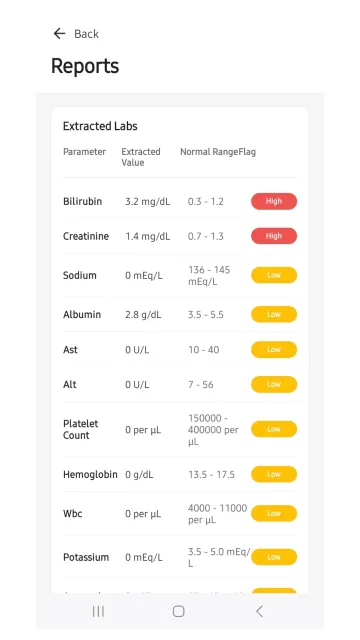
Bilirubin, INR, creatinine, sodium, albumin.
Vitals
BP, heart rate, SpO₂, glucose, sleep, weight.
Symptoms
Daily notes on fatigue, swelling and more.
Diet
Sodium and protein intake against targets.
Fluid intake
Daily mL, important with ascites.
Medications
Checklist, reminders and adherence rate.
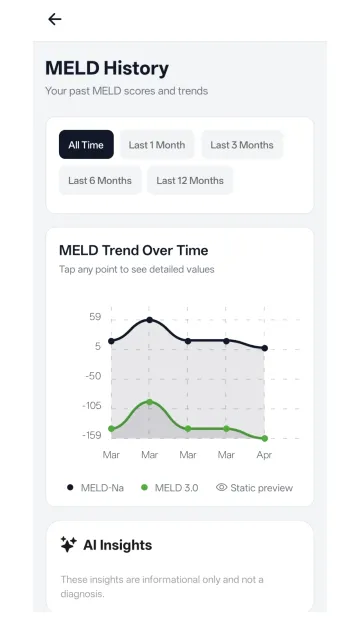
MELD 3.0 trend
Illustrative exampleSample data for illustration only. Scores change as lab values change, which is why clinicians re-assess MELD regularly.
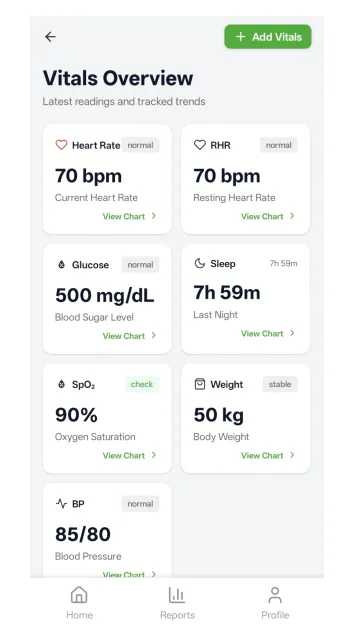
The Liverlytics app
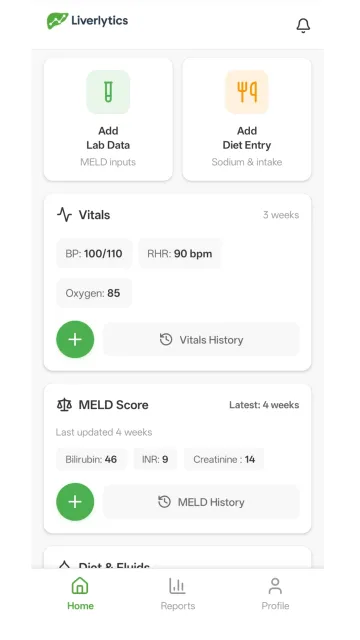
Empowering cirrhosis patients with smarter health tracking
Monitor vital signs, calculate MELD scores, track diet and medications, detect early warning flags and generate clinician-ready summaries — built with patient safety and simplicity in mind.
Local-first secure tracking
Your data stays on your device unless you choose to share it.
MELD-Na & MELD 3.0 calculator
Calculate, save and view MELD score trends over time.
Diet & fluid counter
Tally daily sodium (mg) and fluids (mL) against your targets.
Medication checklist & adherence rate
Stay on schedule with reminders and see how consistently doses are taken.
AI-based insight cards
Highlights anomalies in vitals and lab values in plain language.
Clinician visit summary export
Generate and share a PDF report before your appointment.
Hepatology · Liver disease severity
MELD 3.0 score calculator
The Model for End-Stage Liver Disease (MELD 3.0) combines bilirubin, creatinine, INR, sodium, albumin and sex into a single score from 6 to 40.
Cirrhosis knowledge hub
Clear, structured guides to liver cirrhosis
Start with the basics, then follow the journey from symptoms and causes to stages, treatment, diet and transplant.
Fibrosis vs. Cirrhosis
Where scarring begins and when it can still reverse.
Learn moreLiver Transplant
When transplant is considered and how eligibility works.
Learn moreMELD 3.0 Explained
What the MELD 3.0 score measures and what changed.
Learn moreSymptoms
Early and late warning signs, from fatigue to jaundice.
Learn moreCauses
Alcohol, viral hepatitis, fatty liver, autoimmune and more.
Learn moreStages
Compensated to end-stage liver disease, explained.
Learn moreTreatment & Management
Slowing progression and managing complications.
Learn moreDiet & Nutrition
Low-sodium eating, protein, meal timing and fluids.
Learn morePatient & caregiver stories
Why people use Liverlytics
Liverlytics helps me track symptoms, medications, and appointments easily. Managing cirrhosis feels less stressful, and reminders ensure I never miss important health routines.
Liverlytics supports our family while caring for my father with cirrhosis. The app tracks symptoms, medications, and diet clearly, helping us stay organized daily.
Liverlytics is a useful digital health tool for cirrhosis patients. It encourages symptom tracking, medication adherence, and better awareness, supporting improved patient engagement.
Using Liverlytics every day makes managing cirrhosis easier. I can monitor symptoms, follow medication reminders, and understand my liver health with simple insights.
Liverlytics empowers patients with cirrhosis to monitor health. The app provides reminders, symptom tracking, and helpful information supporting disease management.
Liverlytics makes it easier to stay on top of my liver health. The reminders, symptom tracker, and simple insights help me manage cirrhosis confidently every day.
FAQ
Common questions about cirrhosis and Liverlytics
What causes cirrhosis?
The main causes include chronic hepatitis B or C, long-term heavy alcohol use, non-alcoholic fatty liver disease (NAFLD, now also called MASLD) and autoimmune conditions. Less common triggers are genetic disorders such as hemochromatosis or Wilson’s disease. Early intervention on these factors can slow progression.
What are the early symptoms of cirrhosis?
Early cirrhosis often has no symptoms, earning it the “silent” label, but subtle signs include fatigue, mild appetite loss and weight changes. As it advances, symptoms like jaundice, swelling in the legs or abdomen and easy bruising appear. Regular check-ups can catch it early through blood tests.
How is cirrhosis diagnosed?
Doctors start with a physical exam, medical history and blood tests for liver function. Imaging such as ultrasound or FibroScan follows, with a biopsy confirming scarring in unclear cases. Useful questions to ask include: “What’s causing my cirrhosis?” and “Can it be slowed?”
Can cirrhosis be reversed?
Early-stage (compensated) cirrhosis can improve or stabilise by treating the cause, such as antivirals for hepatitis C or stopping alcohol. Advanced scarring is irreversible, but managing complications extends life. Liver transplant is an option for end-stage cases.
Where is my data stored in the Liverlytics app?
Liverlytics uses local-first tracking: your data stays on your device unless you choose to share it.
Does the website MELD calculator send my lab values anywhere?
No. The MELD 3.0 calculator on this website runs entirely in your browser; the values you enter are not sent to our servers.
Get started